

Revenue leakage is the money an eCommerce business loses through preventable errors, process gaps, fraud, or costs that are not properly recovered. For Shopify merchants, it can appear in unexpected discounts, incorrect inventory records, avoidable refunds, payment disputes, pricing inconsistencies, and discrepancies between sales reports and financial records.
The challenge is that revenue leakage rarely appears as one obvious problem in a single dashboard. A store can report growing sales while its profit margins deteriorate because discounts are too generous, returned products cannot be resold, stock records are inaccurate, or operational costs are not reflected in product-level profitability.
Shopify’s own guidance on revenue leakage recommends auditing financial and inventory records, reviewing promotions and pricing, reconciling payment transactions, and monitoring relevant performance indicators. Its profit reporting documentation also confirms that discounts and refunds affect reported gross margins, while product-level profit reporting depends on accurate cost data.
For business leaders, the objective is not simply to reduce expenses. It is to identify where expected commercial value disappears, quantify the financial impact, and introduce controls that prevent the same losses from recurring.
This 2026 playbook sets out a practical approach to identifying, prioritising, and addressing hidden profit loss across a Shopify operation.
1. What Revenue Leakage Means for a Shopify Business
Revenue leakage occurs when a business fails to collect the revenue it should earn or loses value through avoidable operational and financial inefficiencies. In eCommerce, the problem extends beyond unpaid invoices. It can also include pricing errors, excessive discounting, inventory discrepancies, preventable refunds, and fraud-related losses.
It is important to distinguish revenue leakage from ordinary operating expenses. Payment processing fees, legitimate returns, and planned promotional discounts are not automatically revenue leakage. They become potential leakage when they exceed the business’s intended commercial terms, result from preventable failures, or are not accounted for accurately.
Consider a Shopify merchant that increases monthly sales but sees its gross profit remain flat. The cause might be a combination of deeper discounts, higher return costs, inaccurate product cost records, and stock that cannot be sold because availability data is unreliable.
Each issue may sit within a different team or system. Marketing controls promotions, operations manages stock, finance reconciles payments, and eCommerce manages the storefront. Without a shared view of the customer and order lifecycle, the combined financial impact can remain hidden.
A useful starting point is to separate four measures:
| Measure | What it tells you |
| Gross sales | The value of products sold before relevant deductions |
| Net sales | Sales after applicable discounts and returns, according to the reporting definition |
| Gross profit | Net sales less the cost of goods sold |
| Contribution profit | The amount remaining after the variable costs included in your chosen contribution model |
These measures are not interchangeable. Shopify’s reporting definitions distinguish gross sales, net sales, returns, discounts, and cost of goods sold. Contribution profit requires a broader business definition that may include fulfilment, payment fees, shipping subsidies, and acquisition costs.
Before investigating individual leaks, leadership should agree on which financial measure is being protected. Otherwise, a team may celebrate revenue growth while another reports declining profitability, with both using different definitions.
2. The Six Hidden Sources of Profit Leakage
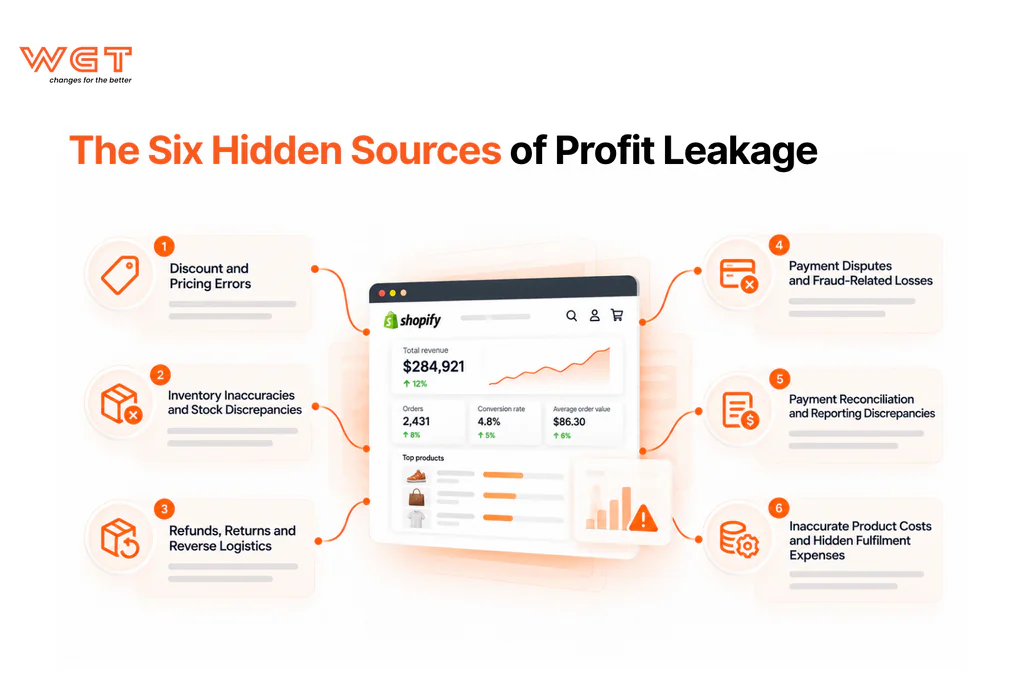
Discount and pricing errors
Promotions can increase conversion and average order value, but uncontrolled discounting can reduce margin faster than it increases profitable demand. Common problems include expired codes remaining active, overlapping offers, incorrect discount eligibility, unauthorised manual adjustments, and first-purchase promotions being repeatedly claimed by the same customer.
Shopify’s retail guidance identifies promotional abuse as a potential source of loss, including customers exploiting welcome discounts or referral rewards through multiple accounts.
Merchants should review discount usage by campaign, code, customer segment, product, and order value. Compare the actual discount against the approved promotion rules, then assess whether the resulting orders generate sufficient gross profit.
The solution is not to eliminate discounts. It is to establish clear promotion ownership, expiry dates, eligibility conditions, and margin thresholds. Any discount intended to support acquisition or retention should be evaluated against its commercial purpose.
Inventory inaccuracies and stock discrepancies
Inventory leakage occurs when recorded stock does not match physical stock or when products become unavailable, damaged, obsolete, or incorrectly allocated across channels.
The consequences are broader than the cost of missing items. A stockout can interrupt a successful campaign, an inaccurate availability status can lead to cancelled orders, and excess inventory can tie up cash while storage and handling costs accumulate.
Shopify’s 2026 inventory guidance identifies administrative errors, stock discrepancies, and failures in inventory processes as issues that can affect retail profitability.
A practical inventory audit should compare recorded quantities with physical counts, review stock adjustments by reason, and identify products with recurring discrepancies. Where a business sells through multiple channels or locations, inventory updates and order allocation should be checked across the connected systems.
For Shopify merchants with complex operations, ERP or inventory integration may help establish a more consistent view of stock. However, integration alone does not guarantee accuracy. The underlying processes for receiving, picking, returns, adjustments, and reconciliation must also be reliable.
Refunds, returns, and reverse logistics
A refund can be entirely legitimate while still exposing a profitability problem. The financial impact may include the refunded product value, outbound and return shipping, handling, inspection, repackaging, and the possibility that a returned item cannot be resold at its original price.
The risk increases when return reasons are not recorded consistently, refunds are processed without the correct return status, or returned stock is not inspected and made available for resale promptly.
Shopify’s reporting documentation makes an important distinction: returns and refunds can appear differently across sales and payments reports because they represent different aspects of the transaction. Report timing and date ranges can also affect the figures shown.
Merchants should therefore reconcile refunds with the original orders, payment transactions, return records, and inventory movements. Analyse return rates by product, variant, reason, and sales channel to identify patterns such as sizing issues, damaged goods, inaccurate descriptions, or repeated refund exceptions.
The aim is to reduce preventable returns and recover value where possible, without making legitimate customer service unnecessarily difficult.
Payment disputes and fraud-related losses
A completed checkout does not guarantee that the sale will remain profitable. Chargebacks can reverse a transaction after goods have been dispatched, while fraud-related orders may also consume inventory, fulfilment capacity, and customer support resources.
Shopify explains that a chargeback can result in the disputed amount and a chargeback fee being deducted from the merchant. It also provides chargeback monitoring for eligible Shopify Payments transactions, helping merchants review dispute patterns and identify areas for prevention.
Merchants should monitor disputes by reason, including unrecognised transactions, alleged non-delivery, duplicate charges, and product-related complaints. They should also review suspicious orders before fulfilment, maintain delivery evidence, communicate shipping delays, and ensure that billing descriptors and refund policies are clear.
Fraud controls must be proportionate. Automatically rejecting every unusual order may reduce some losses but can also block legitimate customers. The objective is to improve risk detection while preserving a reasonable purchasing experience.
Payment reconciliation and reporting discrepancies
One of the most difficult sources of hidden profit loss is a mismatch between what the store records, what the payment provider processes, and what finance expects to receive.
These differences do not always indicate lost money. Shopify documents several legitimate reasons why reports may differ, including refund timing, returns recorded on separate dates, differences between sales reports and order exports, and the treatment of certain order adjustments.
The risk arises when teams assume that every discrepancy is normal or, conversely, treat every reporting difference as a financial loss without investigating its cause.
A reconciliation process should match order identifiers and payment transaction references across Shopify, payment providers, refunds, fees, and settlement records. Unmatched transactions should be categorised as timing differences, reporting differences, unresolved exceptions, or confirmed losses.
For stores using multiple payment providers or selling across markets, this process may require an accounting or ERP system alongside Shopify Analytics. The appropriate ecommerce software tools depend on transaction volume, reporting complexity, and the business’s existing financial controls.
Inaccurate product costs and hidden fulfilment expenses
A store can price products correctly and still misunderstand its profitability if the cost data used for reporting is incomplete or outdated.
Shopify’s profit reports rely on recorded product costs. If cost per item is missing for a product variant, the corresponding variant may not be represented in product-level profit reporting. Shopify also notes that reported gross margin reflects discounts and refunds during the selected period.
This matters because product margin is only one part of the commercial picture. A product that appears profitable before fulfilment may contribute much less after pick-and-pack fees, shipping subsidies, payment costs, returns, and acquisition expenses are considered.
Merchants should maintain accurate cost records at variant level where applicable and establish a consistent method for allocating relevant variable costs. Review profitability by product, order, channel, and market to identify items that generate sales but contribute less profit than expected.
For leadership, the decision is whether to change pricing, renegotiate supplier or fulfilment terms, adjust promotion strategy, improve operations, or discontinue products that cannot meet the business’s margin requirements.
ECOMMERCE GROWTH
Shopify Case Studies: Lessons from Top Brands for Peak Seasons
The smartest brands read the market in real time, adjust quickly, and keep customers coming back long after the rush is over.
3. How to Calculate and Prioritise Revenue Leakage
The first step is to quantify the difference between the value a business expected to retain and the value it actually retained. Shopify’s revenue leakage guidance offers a simple starting point: potential revenue minus actual revenue equals revenue leakage.
For a Shopify merchant, however, the calculation needs to reflect the type of loss being investigated. An expired discount that reduces realised sales value is different from a chargeback that reverses a completed payment, and both differ from excess fulfilment costs that reduce contribution profit.
A practical approach is to calculate each category separately:
| Leakage category | Suggested calculation | Evidence to review |
| Unintended discounts | Actual discount value outside approved promotion rules | Discount codes, order adjustments, campaign rules |
| Inventory loss | Cost value of confirmed missing or unusable stock | Stock counts, adjustments, write-offs |
| Refund and return loss | Preventable refund value plus unrecovered return and handling costs | Refunds, return reasons, stock disposition |
| Payment disputes | Confirmed unrecovered disputed amounts and associated fees | Payment records, dispute outcomes |
| Reconciliation exceptions | Confirmed amounts that remain unexplained after investigation | Orders, transactions, settlements, refunds |
| Margin erosion | Expected contribution profit minus actual contribution profit, using a consistent model | Product costs, discounts, fulfilment, payment and acquisition costs |
These calculations should not be added together blindly. A single order could involve a refund, a stock write-off, and a payment adjustment, so summing every recorded value may count the same underlying loss more than once.
Instead, assign each loss to a primary category, record related costs separately, and distinguish confirmed losses from estimates and unresolved exceptions.
Prioritise by financial impact, not by visibility
Not every discrepancy deserves the same urgency. A small recurring discount error may cost more over a quarter than a single large but legitimate refund. An inventory issue affecting a high-volume product may be more urgent than a larger discrepancy involving a discontinued item.
A useful prioritisation model considers four factors:
- Financial exposure: How much money has been lost or is at risk?
- Recurrence: Is the issue isolated or repeated across many orders?
- Business impact: Does it affect cash flow, margin, customer experience, or operational capacity?
- Control effectiveness: Can the issue be prevented through a reliable process or system change?
For example, a merchant discovers that an outdated welcome code has generated £8,000 in discounts over a quarter, including £3,000 that did not comply with the intended promotion rules. The £3,000 is a potential confirmed leakage amount only after the merchant validates the rules, customer eligibility, and transaction records. The remaining £5,000 may represent legitimate promotional expenditure.
That distinction matters. The objective is to recover or prevent avoidable losses, not to label every commercial cost as leakage.
4. The 30-Day Revenue Leakage Recovery Playbook
Once the main sources of leakage have been identified, Shopify merchants need a repeatable process to investigate the causes, implement controls, and verify whether the changes work.
- Days 1 to 7: Establish the baseline
Collect sales, profit, discount, refund, inventory, payment, and settlement data. Agree on financial definitions, identify reporting differences, and create a register of potential leakage with a named owner for each issue.
- Days 8 to 14: Validate the largest losses
Investigate the highest-value and most frequently recurring exceptions. Reconcile orders with payments, verify discount eligibility, check stock discrepancies, and examine refund and chargeback patterns. Separate confirmed losses from timing differences and estimates.
- Days 15 to 21: Implement corrective controls
Fix expired or incorrectly configured promotions, update incomplete product costs, improve stock and payment reconciliation, and address the process failures causing preventable returns or disputes. Assign an accountable owner and document each change.
- ays 22 to 30: Verify recovery and monitor recurrence
Compare results with the baseline, confirm that the corrective changes reduced the targeted loss, and establish ongoing exception reports. Document realised savings separately from estimated avoided losses.
This is a proposed operating framework, not a guaranteed recovery timeline. Complex payment integrations, large inventories, or incomplete historical records may require more than 30 days. The sequence can still help leadership establish ownership and focus effort on the most material risks first.
5. Build a Revenue Leakage Dashboard That Connects Operations to Profit
A revenue leakage dashboard should help leaders understand not just what changed, but why it changed, how much it matters, and who is responsible for resolving it.
Shopify Analytics provides sales, traffic, and transaction reporting, while its profit reports support product-level analysis when the required cost data has been recorded. These reports provide a useful foundation, but merchants may need additional accounting, inventory, or business intelligence systems for full reconciliation across payment providers, fulfilment operations, and acquisition costs.
The dashboard should focus on a small set of actionable indicators:
| KPI | What leadership should monitor |
| Unapproved discount value | Discounts outside authorised promotion rules |
| Inventory discrepancy value | Confirmed difference between recorded and actual stock value |
| Refund and return cost | Refund value, return handling costs, and unrecoverable stock |
| Chargeback rate and cost | Dispute patterns, disputed amounts, fees, and outcomes |
| Unreconciled payments | Value and age of unresolved transaction exceptions |
| Gross margin by product | Margin after recorded product costs, discounts, and refunds |
| Contribution profit | Profit remaining after the variable costs included in the agreed model |
| Confirmed leakage recovered | Value actually recovered or prevented, with evidence |
Not every metric should trigger an automatic action. For example, a high return rate could reflect product quality issues, inaccurate descriptions, customer expectations, or a normal category pattern. Investigation is needed before changing the return policy or restricting customers.
Likewise, a reporting discrepancy may be caused by timing or report logic rather than a missing payment. Shopify’s sales discrepancy documentation should be used to validate report definitions before treating differences as losses. The most valuable dashboard is one that links every material exception to an owner, a root cause, a corrective action, and a verified financial result.
6. How Technology Helps Prevent Revenue Leakage
Manual audits are useful for finding existing problems, but recurring leakage requires controls that operate consistently as order volume grows.
For a smaller Shopify store, the first improvements may be straightforward: standardise promotion rules, maintain product cost data, review refunds weekly, and reconcile payments on a defined schedule. A more complex business selling across several markets, warehouses, and channels may need stronger integration between Shopify, ERP, CRM, payment providers, and accounting systems.
The right ecommerce software should support the controls the business actually needs. An inventory management system can help maintain stock visibility, an accounting platform can support financial reconciliation, and an ecommerce marketing software stack can help enforce promotion rules and evaluate campaign profitability. Additional ecommerce tools are only valuable when they improve control, reduce manual effort, or provide information that changes a decision.
Integration design matters just as much as software selection. Merchants should establish clear ownership of product, inventory, order, refund, and payment data. They should also define how errors are detected, how failed synchronisations are retried, and how duplicate or conflicting updates are handled.
Automation can flag unusual discount patterns, overdue reconciliation items, or inventory discrepancies, but it should not be treated as a substitute for accurate source data and clear financial definitions. A poorly designed automated process can repeat an error at greater scale.
For C-level leaders, the business case should be based on measurable outcomes: reduced confirmed leakage, fewer recurring exceptions, lower manual reconciliation effort, improved stock accuracy, and more reliable contribution profit reporting.
How WGT Core Helps Shopify Merchants Protect Profitability
Revenue leakage is often a cross-functional problem. A promotion issue may originate in marketing, an inventory discrepancy in operations, a reporting gap in finance, or a synchronisation failure between Shopify and an external system.
WGT Core supports eCommerce businesses through Shopify development, custom theme and app development, ERP and CRM integrations, platform migration, and conversion rate optimisation. Depending on the underlying issue, these services can help merchants improve the reliability of their storefront and connected systems, reduce manual work, and create a clearer foundation for operational reporting.
The starting point should always be a defined business problem. A merchant struggling with inconsistent stock records may need an inventory integration review. A store with unexplained payment discrepancies may need a more reliable transaction reconciliation workflow. A business whose promotions generate sales without sufficient margin may need better visibility into product economics and campaign performance.
Technology cannot eliminate every commercial risk, but a well-designed system can make exceptions easier to detect, investigate, and prevent.
Want to identify the operational gaps affecting your Shopify store’s profitability? Contact WGT Core to discuss your eCommerce infrastructure, system integrations, and growth priorities.
ECOMMERCE GROWTH
Your eCommerce Platform Should Power Growth, Not Limit It.
From Shopify development to complex integrations, WGT Core helps ambitious eCommerce businesses build for performance and scale.
Conclusion
Revenue leakage is rarely caused by one isolated failure. It often develops through small, recurring gaps in discount management, inventory accuracy, returns, payment reconciliation, and cost visibility.
For Shopify merchants, the priority is to establish reliable financial definitions, quantify confirmed losses, investigate their root causes, and introduce controls that prevent recurrence. A structured audit, supported by accurate reporting and appropriate integrations, can help leadership protect margins without relying on indiscriminate cost-cutting.
The real measure of success is not the number of discrepancies identified. It is the amount of confirmed loss prevented or recovered, the reduction in recurring exceptions, and the improvement in profit visibility that enables better businessdecisions.