


The commercial impact of data drift extends beyond a lower conversion rate. When campaign signals become less reliable, businesses risk allocating budget to the wrong audiences, scaling campaigns that no longer generate profitable demand, or cutting campaigns that still contribute meaningful revenue.
Consider a Shopify store that generates $100,000 in monthly attributed revenue from $25,000 in advertising spend. Its reported ROAS is 4.0x. If attribution changes and the platform begins reporting only $80,000 in attributed revenue, reported ROAS falls to 3.2x, even if the store’s actual sales remain unchanged. The team may reduce spending unnecessarily unless it first investigates the discrepancy.
The reverse is equally dangerous. If duplicate purchase events inflate attributed revenue, the business may increase spend based on a misleading performance signal.
Even when the decline is genuine, revenue alone does not reveal the full impact. Rising acquisition costs, lower average order value, deeper discounts, and higher return rates can reduce contribution margin despite stable sales volume.
For C-level leaders, the priority is to distinguish three questions: Are customers behaving differently? Is the measurement system accurately recording their behavior? And are the resulting sales still economically attractive? Answering these questions separately helps teams protect marketing budgets and make better investment decisions.
How to Detect Data Drift Before It Damages ROAS
The most effective way to identify data drift is to monitor acquisition, conversion, measurement, and financial performance together. No single metric can explain every decline, but patterns across these layers can narrow the investigation.
Start by comparing current performance with a relevant historical baseline. Review the same campaign, audience, product, device, and landing page across comparable periods. Account for seasonality, promotional activity, traffic volume, and other factors that could explain normal variation.
Next, inspect the conversion funnel. Shopify’s behavior reports allow merchants to examine sessions, cart additions, checkout progression, completed purchases, and conversion rates over time. These metrics help identify where customers stop progressing through the purchase journey.
| Performance pattern | What to investigate first |
| Clicks remain stable, but add-to-cart activity declines | Audience intent, product relevance, pricing, and landing-page experience |
| Add-to-cart activity remains stable, but purchases decline | Shipping costs, payment errors, checkout friction, and inventory |
| Shopify orders remain stable, but reported ad conversions fall | Tracking configuration, attribution settings, and reporting delays |
| Revenue increases, but ROAS or contribution margin falls | Acquisition costs, discounting, average order value, and product margins |
| Performance declines after a website update | Theme changes, app conflicts, scripts, and conversion-event implementation |
These patterns are diagnostic clues, not definitive explanations. A decline in add-to-cart activity, for example, could reflect a less relevant audience or a product that has become less attractive. The next step is to test the most plausible explanations against actual store data.
Measurement validation is equally important. Google Ads provides conversion diagnostics for identifying inactive or misconfigured conversion actions and problems with tracking tags. Merchants should also compare platform-reported conversions with Shopify orders, accounting for differences in attribution models, consent, and reporting windows.
One additional consideration is measurement methodology. Shopify’s session-measurement update scheduled for September 21 to 23, 2026, can change reported sessions and session-based conversion rates without necessarily changing orders or customer behavior. Merchants comparing periods across this update should establish a consistent new baseline and examine orders and sales alongside session metrics.
The goal is to identify the earliest point at which observed behavior diverges from expectations, then establish whether that divergence reflects a genuine business problem, a measurement issue, or both.
ECOMMERCE GROWTH
Your eCommerce Platform Should Power Growth, Not Limit It.
From Shopify development to complex integrations, WGT Core helps ambitious eCommerce businesses build for performance and scale.
How to Prevent and Respond to Data Drift
Data drift cannot be eliminated entirely because markets, customers, and product demand naturally evolve. What businesses can control is how quickly they detect changes and how reliably they respond.
An effective process begins with a documented baseline for campaign performance, conversion behavior, and measurement quality. Teams should agree on the definitions of key metrics, including purchases, attributed revenue, conversion rate, and ROAS. Without consistent definitions, marketing and eCommerce teams can reach different conclusions from the same underlying activity.
Monitoring should then focus on meaningful changes rather than every short-term fluctuation. Set alerts for sustained deterioration in conversion rates, unexpected discrepancies between orders and reported purchases, broken conversion events, and integration failures. Thresholds should reflect the store’s historical variability, traffic volume, and financial exposure rather than arbitrary universal targets.
When an alert fires, investigate before changing the campaign. Check recent creative and audience changes, product availability, promotional conditions, website releases, and tracking configuration. Where possible, isolate one variable at a time and measure the outcome against the same baseline. This reduces the risk of replacing effective campaigns or introducing new problems while trying to fix existing ones.
Finally, make data quality part of ongoing operational governance. Assign clear ownership for tracking, integrations, campaign reporting, and storefront performance. Document changes to the measurement setup and test critical purchase events after significant website updates.
For larger eCommerce operations, automated monitoring and centralized reporting can reduce the time spent reconciling disconnected systems. The investment should be proportional to the complexity of the business: a smaller merchant may need a disciplined analytics review, while a multi-market retailer with several sales channels may require more sophisticated integration monitoring.
Why Shopify Stores Need a Connected Data Strategy
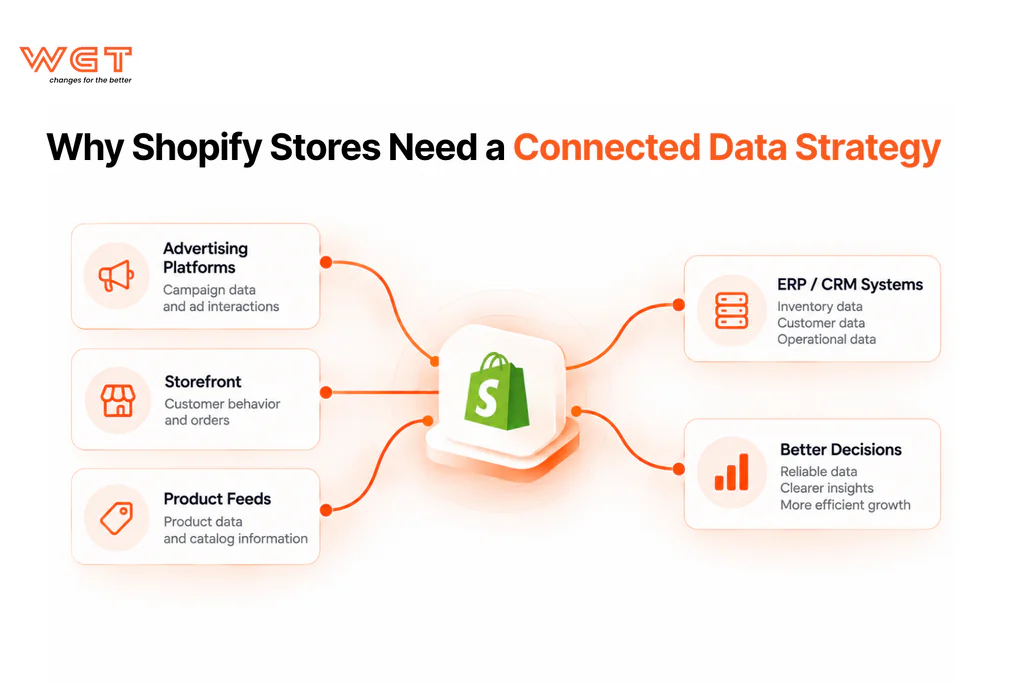
Shopify merchants depend on several connected systems to understand and serve customers. Advertising platforms capture campaign interactions, Shopify records store activity and orders, product feeds communicate catalog information, and ERP or CRM systems may hold inventory, customer, and operational data.
When these systems become disconnected, teams can make decisions using incomplete or inconsistent information. An advertising platform may report a conversion decline while Shopify orders remain stable. A product feed may promote an unavailable item. A recent theme change may affect tracking without an obvious error on the storefront.
A connected data strategy helps businesses establish consistent definitions, reliable data flows, and clear ownership across these systems. It also makes it easier to distinguish a marketing problem from a storefront, integration, or measurement problem.
This does not mean that every store needs a complex data warehouse or a new technology platform. The right starting point is to identify where information becomes unreliable, which decisions depend on that information, and what it would cost the business to act on an incorrect signal.
For example, a merchant experiencing discrepancies between advertising conversions and Shopify orders should first validate event implementation and reporting definitions. A retailer facing frequent stock-related cancellations may need better inventory synchronization. A store with healthy traffic but declining checkout completion may need a closer review of payment flows, shipping information, and mobile usability.
In each case, the technology decision should follow the evidence. Better architecture and integrations are valuable when they solve a defined business problem, improve data reliability, or reduce the time needed to make a sound decision.
How WGT Core Helps Improve eCommerce Performance
When a previously successful advertising campaign starts underperforming, the cause may lie beyond the advertising platform. Shopify storefront performance, theme and app changes, tracking implementation, product data, and system integrations can all affect the reliability of marketing decisions and the customer experience.
WGT Core supports eCommerce businesses through Shopify development, theme and app customization, system integrations, migration, and conversion rate optimization. These capabilities can help businesses investigate technical barriers, improve the consistency of data flows, and strengthen the shopping experience.
The right approach depends on the problem identified. A tracking discrepancy may require an implementation audit, while a checkout decline may call for a review of storefront behavior and payment flows. Businesses managing fragmented operational data may need to examine their ERP or CRM integrations before investing in additional marketing technology.
The objective is to connect technical improvements with measurable business outcomes, including more reliable reporting, fewer operational errors, better conversion experiences, and more informed allocation of marketing spend.
Are your best-performing ads losing conversions? Contact WGT Core to discuss your Shopify store, integration architecture, and conversion optimization priorities.
ECOMMERCE GROWTH
Turn Your eCommerce Data into Better Decisions
WGT Core helps eCommerce businesses strengthen their Shopify technology stack through custom development, system integration, and conversion rate optimization, giving teams a more reliable foundation for growth.
Conclusion
When a high-performing ad campaign stops converting, the visible decline is not always the root problem. Data drift, changing customer behavior, inaccurate measurement, and storefront friction can produce similar symptoms while requiring very different solutions.
The most effective response is to validate the data, identify where the conversion funnel changes, and connect marketing performance to actual orders and profitability before making major campaign decisions.
For Shopify merchants, reliable data and a well-performing storefront are essential foundations for sustainable growth. By improving measurement quality, monitoring critical integrations, and responding to changes with evidence, businesses can protect advertising efficiency and make more confident decisions as customer behavior evolves.