

Choosing an eCommerce platform is one of the most consequential technology decisions a business can make. The platform influences how products are managed, how customers interact with a storefront, how orders move through the business, and how easily the company can expand into new markets.
For businesses with complex commerce requirements, Magento has remained a notable option because of its flexibility, extensive customization capabilities, and broad integration possibilities.
Now part of Adobe Commerce, the Magento ecosystem supports a range of commerce capabilities, from catalog and inventory management to B2B workflows, content management, APIs, and AI-powered product discovery.
However, having a long feature list does not automatically make a platform the right investment. The real value lies in how effectively those features support business operations, customer experience, and long-term growth.
This guide explores the most important Magento features, explains their business applications, and helps decision-makers understand when Magento Open Source or Adobe Commerce may be the right fit.
1. Understanding Magento: More Than an eCommerce Website Builder
Magento is an open-source eCommerce platform originally developed to give businesses greater control over their online commerce operations. Today, its technology is part of Adobe Commerce, which offers different products and deployment models for businesses with varying requirements.
There are two important offerings to distinguish.
Magento Open Source provides core commerce functionality and an extensible codebase. Businesses can use, customize, and deploy it without paying a commercial software license fee, although hosting, development, maintenance, and other operating costs still apply.
Adobe Commerce builds on the Magento foundation with additional enterprise capabilities, commercial services, and deployment options. Depending on the product and configuration, these can include advanced B2B functionality, content staging, shared catalogs, and AI-powered commerce services.
This distinction matters because not every feature associated with Adobe Commerce is automatically available in Magento Open Source.
For business leaders, Magento’s appeal comes from its ability to support different commerce models while allowing organizations to shape the technology around their operating requirements.
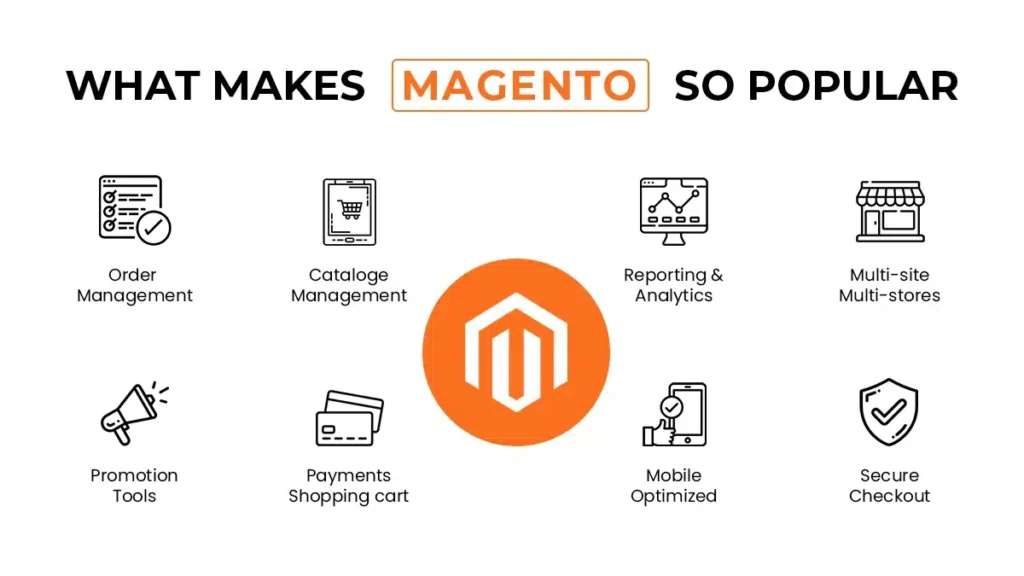
2. 12 Key Magento Features That Support eCommerce Growth
Magento’s capabilities cover several areas of digital commerce. The following features are particularly relevant to businesses managing complex catalogs, multiple customer segments, and connected operations.
2.1 Flexible Product Catalog Management
A product catalog is more than a collection of items displayed on a website. It is a core business asset that influences merchandising, navigation, search, inventory, and customer experience.
Magento supports multiple product types, including:
- Simple products
- Configurable products
- Grouped products
- Bundle products
- Virtual products
- Downloadable products
These options allow businesses to represent different product structures and purchasing models.
For example, a fashion retailer can use configurable products to organize variations such as size and color. A technology distributor can use grouped or bundled products to present related items together.
Magento also provides category management, product attributes, pricing configuration, and catalog navigation tools.
Business value: Flexible catalog management allows companies to organize complex product ranges without forcing every product into the same structure. This can improve merchandising efficiency and create a more intuitive product discovery experience.
2.2 Advanced Product and Pricing Management
Different customers do not always require the same product presentation or pricing structure.
A wholesale buyer may receive negotiated prices, while a retail customer sees standard public pricing. A distributor may need access to a specific product assortment, while another customer segment requires different purchasing conditions.
Magento provides product attributes, price rules, catalog structures, and customer segmentation capabilities to support these requirements.
Adobe Commerce extends this further through B2B capabilities such as shared catalogs and company-specific pricing.
For businesses with complex commercial arrangements, these features can reduce the need to manage every pricing scenario manually.
Business value: More structured pricing and catalog management can support different customer segments, reduce administrative friction, and help sales teams manage complex commercial relationships.
2.3 Multi-Store and Multi-Website Management
Expanding into new markets often introduces additional operational complexity.
Businesses may need different storefronts for separate brands, countries, customer groups, or product lines. Managing these environments independently can create duplicated work and inconsistent product information.
Magento supports a hierarchical structure that allows businesses to manage multiple websites, stores, and store views within a single installation.
This structure can support:
- Multiple brands or business units.
- Different storefronts for regional markets.
- Multiple languages and currencies.
- Localized product catalogs.
- Different pricing and store configurations.
The exact implementation depends on the business architecture and its requirements.
Business value: Multi-store capabilities can help businesses manage diverse storefront experiences within a more coordinated commerce environment. This is particularly useful for organizations operating across multiple markets or brands.
2.4 Built-In Inventory Management and Multi-Source Inventory
Inventory accuracy has a direct effect on order fulfillment, customer satisfaction, and operational efficiency.
Magento Open Source and Adobe Commerce include inventory management capabilities, while Multi-Source Inventory (MSI) allows merchants to manage stock across multiple inventory sources.
Businesses can define different stock locations and assign inventory sources to sales channels.
For example, a retailer operating multiple warehouses may use separate inventory sources to represent available stock across locations.
This can support more structured inventory visibility and order allocation.
However, inventory management should not be confused with a complete warehouse management system. Businesses with complex warehouse operations may still need dedicated WMS or ERP integrations.
Business value: Better inventory visibility can help businesses coordinate stock across locations, reduce manual inventory management, and support more informed fulfillment decisions.
2.5 B2B Commerce Capabilities
B2B commerce involves more complex purchasing relationships than a typical consumer storefront.
Wholesale buyers and corporate customers may require negotiated pricing, company accounts, purchasing permissions, purchase orders, and approval workflows.
Adobe Commerce provides dedicated B2B capabilities designed to support these requirements.
Depending on the product and configuration, these include:
- Company accounts and organizational structures.
- Buyer roles and permissions.
- Shared catalogs.
- Negotiated pricing.
- Quote management.
- Purchase orders.
- Requisition lists.
- Order approval workflows.
These capabilities help businesses support purchasing processes that involve multiple users and decision-makers within the same organization.
It is important to note that these advanced B2B capabilities are associated with Adobe Commerce and should not be assumed to be part of every Magento Open Source installation.
Business value: For wholesalers, manufacturers, and distributors, structured B2B functionality can support more complex purchasing relationships and reduce the need to manage every transaction through manual sales processes.
2.6 Flexible Promotions and Merchandising
Promotions influence customer acquisition, average order value, and purchasing decisions.
Magento provides configurable cart price rules and catalog price rules that allow businesses to define promotional conditions.
Common use cases include:
- Percentage-based discounts.
- Fixed-amount discounts.
- Buy-one-get-one offers.
- Coupon-based promotions.
- Minimum purchase conditions.
- Product or category-specific discounts.
Businesses can also use catalog and merchandising tools to organize how products are presented across storefronts.
For more advanced campaign management, Adobe Commerce offers additional capabilities such as content staging and scheduling, depending on the product and deployment.
Business value: More flexible promotional controls allow marketing and merchandising teams to implement campaigns around specific commercial objectives without relying entirely on manual product or pricing changes.
ECOMMERCE GROWTH
Content Marketing for eCommerce Websites: Your Comprehensive Guide
For eCommerce businesses, attracting visitors is only one part of building a successful online store. Customers also need relevant information, clear product explanations, and reasons to trust a brand before making a purchase.
2.7 Content Management and Page Builder
The storefront experience plays an important role in how customers understand products and interact with a brand.
Magento provides content management functionality for managing pages, blocks, and storefront content.
Adobe Commerce also offers Page Builder, a visual content management tool that allows users to create and manage content-rich pages through a drag-and-drop interface.
This can help marketing teams build landing pages and campaign experiences using available content components.
Page Builder availability should be checked against the specific Adobe Commerce product and deployment model.
Business value: A more flexible content workflow can reduce dependency on developers for routine content changes and help marketing teams respond more efficiently to campaigns and seasonal opportunities.
2.8 Extensive Customization and Extension Ecosystem
One of Magento’s defining characteristics is its extensibility.
Businesses can modify existing functionality, develop custom modules, and integrate third-party extensions to support specific operational requirements.
Examples include:
- Custom checkout workflows.
- Specialized product configuration.
- Loyalty and membership functionality.
- Payment gateway integrations.
- Advanced search solutions.
- Custom customer account experiences.
- Business-specific pricing logic.
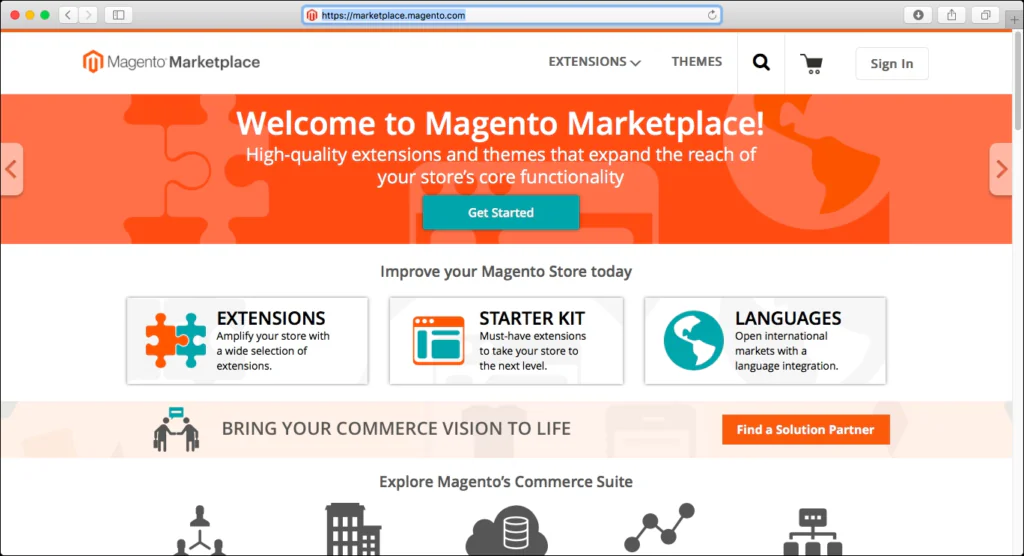
Magento’s extension ecosystem also provides additional tools and modules through the Magento Marketplace and other providers.
However, adding more extensions is not always the best solution. Poorly selected or incompatible modules can introduce technical debt, performance issues, and upgrade challenges.
Business value: Customization allows businesses to build around their competitive processes instead of adapting every operation to a fixed platform structure.
2.9 API-Driven Architecture and Headless Commerce
Modern eCommerce businesses increasingly need to deliver commerce experiences across multiple channels.
A storefront may need to connect with mobile applications, digital kiosks, customer portals, marketplaces, or other digital touchpoints.
Magento provides APIs, including REST and GraphQL capabilities, that enable developers to connect commerce functionality with external applications and frontend experiences.
This creates opportunities for headless commerce architectures, where the frontend experience is separated from the commerce backend.
Businesses can select frontend technologies that suit their experience and performance requirements while continuing to use Magento for core commerce operations.
However, headless architecture introduces additional development, integration, hosting, and maintenance considerations. It should be adopted when it solves a defined business or technical problem.
Business value: API-driven architecture can provide greater flexibility in how businesses deliver commerce experiences across channels, while allowing the backend and frontend to evolve independently.
2.10 SEO-Friendly Storefront Capabilities
Organic search remains an important acquisition channel for many eCommerce businesses.
Magento provides several tools that can support technical and on-page SEO, including:
- Customizable page titles and meta descriptions.
- Product and category URL configuration.
- URL rewrites.
- Canonical URL settings.
- XML sitemap generation.
- Robots.txt configuration.
- Image alternative text.
- Structured product information.
These capabilities provide a foundation for managing search visibility, but they do not guarantee strong rankings.
SEO performance also depends on website architecture, content quality, crawlability, page performance, internal linking, product information, and external authority.
Businesses with large catalogs should pay particular attention to duplicate URLs, faceted navigation, canonicalization, and indexation control.
Business value: A technically sound SEO foundation helps businesses make their product and category pages easier for search engines to discover, understand, and index.
2.11 Security and Access Management
Security is a fundamental requirement for any business handling customer accounts, personal information, and online transactions.
Magento provides security-related capabilities such as:
- Admin user roles and permissions.
- Access control lists.
- Two-factor authentication support.
- CAPTCHA and reCAPTCHA integrations or supported features.
- Secure configuration options.
- Security patch and update mechanisms.
Adobe also publishes security bulletins and platform updates to address vulnerabilities.
However, security is not something the platform can guarantee by itself. Businesses remain responsible for appropriate configuration, access management, extension quality, patching, monitoring, backups, and secure development practices.
Business value: A structured security and maintenance approach helps reduce technology risk and protect business continuity, customer trust, and sensitive data.
2.12 AI-Powered Product Discovery and Recommendations
AI is changing how customers discover products and how retailers manage digital merchandising.
Adobe Commerce’s ecosystem includes AI-powered capabilities such as Live Search and Product Recommendations, subject to product eligibility, service availability, and configuration.
These capabilities can support:
- More relevant product search.
- Intelligent product recommendations.
- Personalized product discovery.
- Merchandising insights.
- Improved navigation across large catalogs.
Adobe also provides newer AI-related commerce services and tools, including catalog enrichment capabilities for supported environments.
These features should not be treated as universally available across all Magento Open Source installations. Their availability depends on the Adobe Commerce product, deployment model, and connected services.
Business value: AI-assisted discovery can help businesses make large product catalogs easier to navigate and create more relevant shopping experiences. Its actual commercial impact should be measured through search engagement, product discovery, conversion, and average order value.

3. Magento Open Source vs Adobe Commerce: Which Features Do You Actually Need?
A common mistake when evaluating Magento is assuming that all features are included in every version.
Magento Open Source and Adobe Commerce share a common technology foundation, but their capabilities and commercial models differ.
The following table provides a high-level comparison.
| Feature | Magento Open Source | Adobe Commerce |
| Core product catalog management | Yes | Yes |
| Product types and attributes | Yes | Yes |
| Multi-website and store views | Yes | Yes |
| Inventory management and MSI | Yes | Yes |
| Cart and catalog price rules | Yes | Yes |
| URL rewrites and SEO configuration | Yes | Yes |
| REST and GraphQL APIs | Yes | Yes |
| Extension and customization capabilities | Yes | Yes |
| Page Builder | Not included as a standard core feature | Available, subject to product and deployment |
| Advanced B2B functionality | Requires custom development or extensions | Dedicated B2B capabilities |
| Shared catalogs | Not included as a standard core feature | Available with B2B capabilities |
| Company accounts and buyer roles | Requires custom development or extensions | Available with B2B capabilities |
| Content staging and scheduling | Not included as a standard core feature | Available, subject to product and deployment |
| AI-powered Live Search and Product Recommendations | Requires separate solutions or services | Available through eligible Adobe Commerce services |
| Commercial Adobe support and services | Not included as a standard commercial license | Available according to commercial agreement |
This is a high-level comparison, not a complete feature matrix. Specific functionality can vary across Adobe Commerce versions, deployment models, and connected services. Businesses should validate requirements against the official documentation for the exact product they plan to use.
When Magento Open Source May Be the Right Choice
Magento Open Source can be suitable for businesses that:
- Need flexibility over their commerce implementation.
- Have technical resources to manage the platform.
- Require custom product and catalog structures.
- Want to avoid a commercial software license fee.
- Can implement additional functionality through custom development or extensions.
For businesses with relatively straightforward commerce requirements but a need for technical control, Magento Open Source may provide a suitable foundation.
When Adobe Commerce May Be the Better Investment
Adobe Commerce may be more appropriate for businesses that:
- Operate complex B2B purchasing models.
- Need advanced company account and shared catalog functionality.
- Require more sophisticated content management workflows.
- Want access to eligible Adobe commerce services.
- Need enterprise-oriented commercial support and deployment options.
The decision should be based on the value of the additional capabilities relative to their licensing, implementation, and operating costs.
4. How Magento Features Translate Into Business Value
The value of an eCommerce platform should not be measured by the number of features it offers.
A feature becomes commercially valuable when it helps the business solve a real operational problem or improve an important customer journey.
The following examples illustrate how Magento capabilities can support business priorities.
| Business Priority | Relevant Magento Capabilities | Potential Business Value |
| Managing complex product ranges | Catalog management, product attributes, configurable products | More structured product information and merchandising |
| Expanding into new markets | Multi-website, store views, localization | More coordinated multi-market operations |
| Improving inventory visibility | Multi-Source Inventory | Better visibility across stock locations |
| Supporting wholesale customers | Adobe Commerce B2B capabilities | More structured business purchasing workflows |
| Improving campaign execution | Promotions, content management, Page Builder | More flexible merchandising and content operations |
| Connecting business systems | REST, GraphQL, custom integrations | More connected data and workflows |
| Improving organic discovery | URL configuration, metadata, XML sitemaps | Stronger technical SEO foundations |
| Supporting personalized experiences | Adobe AI-powered services | More relevant search and product discovery |
For C-level executives, the key is to identify which capabilities directly support the company’s growth strategy.
For example, a manufacturer selling through distributors may prioritize B2B pricing, company accounts, and ERP integration. A direct-to-consumer retailer may place greater emphasis on catalog management, product discovery, promotions, and customer experience.
The same platform can support different business models, but the architecture and implementation should reflect the actual requirements.
ECOMMERCE GROWTH
Best eCommerce Platform Compared: How to Choose the Right One for Your Business
The platform determines how efficiently a company manages its products, processes orders, integrates business systems, serves customers, and responds to changing market demands.
5. What to Consider Before Investing in Magento
Magento offers considerable flexibility, but that flexibility comes with responsibilities.
Before committing to the platform, business leaders should evaluate several factors.
Total Cost of Ownership
The total cost of operating Magento includes more than the initial development investment.
Businesses should consider:
- Hosting and infrastructure.
- Development and customization.
- Extensions and third-party services.
- Security and maintenance.
- Performance optimization.
- Integration development.
- Platform upgrades.
- Internal technical resources.
Magento Open Source does not have a commercial software license fee, but its operational costs can still be significant.
Adobe Commerce introduces additional commercial costs that should be assessed against the value of its enterprise capabilities.
Technical Expertise and Maintenance
Magento is a sophisticated platform that requires appropriate technical knowledge.
Businesses need to consider who will manage code quality, updates, security patches, infrastructure, integrations, and troubleshooting.
Without a structured maintenance approach, customizations and third-party extensions can accumulate technical debt.
Performance and Scalability
Magento can support complex commerce operations, but performance depends on implementation quality and infrastructure.
Businesses should evaluate:
- Server and database configuration.
- Caching strategy.
- Search infrastructure.
- Image and asset optimization.
- Custom code quality.
- Third-party extension performance.
- Integration response times.
Scalability should be designed and tested against actual traffic patterns, transaction volumes, and business requirements.
Integration Requirements
An eCommerce platform rarely operates independently.
Magento may need to exchange data with ERP, CRM, PIM, OMS, payment, fulfillment, and marketing systems.
The complexity of these connections should be understood before implementation because integration architecture can have a significant effect on project cost and ongoing operations.
Upgrade Magento 2.4.x or Migrate to Shopify Plus?
For businesses operating on older Magento versions, deciding whether to continue investing in platform upgrades or move to another commerce solution requires careful evaluation.
An upgrade to Magento 2.4.x may be appropriate when the existing architecture still supports business requirements and the investment in modernization is commercially justified. However, businesses facing increasing maintenance costs, technical complexity, or operational constraints may also consider moving to a managed platform.
Evaluating whether to invest in Magento 2.4.x upgrades or migrate from Magento to Shopify Plus? Our technology consultants provide objective architectural audits to help you choose the highest-ROI pathway.
The decision should account for more than development costs. Businesses should compare the long-term total cost of ownership, customization requirements, integration dependencies, SEO risks, data migration complexity, and internal technical resources before committing to either approach.
6. Is Magento the Right Platform for Your Business?
Magento is not automatically the right solution for every eCommerce company.
Its strongest value is often found in businesses that need greater control over their commerce architecture, product catalog, integrations, and business-specific workflows.
It may be a strong fit for:
- Manufacturers and distributors with complex product catalogs.
- B2B businesses with specialized purchasing requirements.
- Retailers operating multiple brands or storefronts.
- Businesses with established technical teams.
- Organizations that require extensive customization and system integration.
On the other hand, businesses that prioritize a fully managed SaaS environment, simpler infrastructure responsibilities, and faster execution may also want to evaluate alternatives such as Shopify or Shopify Plus.
The right decision depends on the company’s operating model, technical resources, growth objectives, and total cost of ownership.
Building a Better Magento Foundation With WGT Core
A successful Magento implementation requires more than activating platform features. It requires an architecture that connects the storefront, business processes, data, and supporting systems.
WGT Core helps businesses develop and optimize Magento solutions around their specific commerce requirements.
Our Magento development services support custom functionality, performance engineering, integrations, and ongoing platform optimization.
For businesses with complex technology ecosystems, the right eCommerce development approach should also consider how the commerce platform connects with ERP, CRM, PIM, and other operational systems.
And for organizations looking to improve organic visibility, our eCommerce SEO services help strengthen technical foundations, content strategy, and on-page optimization.
Magento’s real advantage is not simply its extensive feature set. It is the flexibility to align commerce technology with the way a business operates, competes, and grows. The most successful implementation is the one that turns the right capabilities into measurable business value.
ECOMMERCE GROWTH
Your eCommerce Platform Should Power Growth, Not Limit It.
WGT Core helps businesses develop and optimize Magento solutions around their specific commerce requirements.