

The holiday shopping season creates a major growth opportunity for eCommerce businesses, but higher traffic does not automatically translate into higher profit. For Shopify merchants, Black Friday, Cyber Monday, and year-end promotions place pressure on every part of the commerce operation, from storefront performance and checkout to inventory accuracy, fulfillment, and customer retention.
The most useful Shopify store examples reveal a consistent lesson: profitable growth depends on how well the entire shopping experience performs under pressure. A successful campaign can attract thousands of additional visitors, but slow product pages, unexpected shipping costs, fragmented inventory data, or delayed order notifications can prevent that demand from becoming completed purchases.
Shopify’s 2025 Global Holiday Retail Report highlights the changing expectations behind this challenge. Based on a survey of 18,000 shoppers and 7,500 businesses across nine countries, the report found that 26% of shoppers began holiday shopping by the end of September, while 51% planned to set clear spending limits for the season. These findings point to two priorities for merchants: prepare early and make the value of every purchase clear.
For business leaders, the strategic question is not simply how to generate more holiday traffic. It is how to convert demand efficiently while protecting margins, maintaining operational reliability, and building customer relationships that continue beyond the promotional period.
Why Shopify Store Benchmarks Matter During the Holiday Season
During ordinary trading periods, performance issues can remain hidden behind relatively stable traffic and manageable order volumes. Holiday peaks expose those weaknesses. A checkout integration that works adequately during normal operations may become a bottleneck when order volume increases. Inventory updates that run periodically may create overselling when several channels sell the same product. Promotional discounts may increase revenue while quietly reducing contribution margin.
Benchmarks give leadership teams a way to identify these weaknesses before they affect revenue. Rather than treating website speed, checkout completion, and fulfillment as separate technical metrics, businesses should evaluate them as interconnected drivers of commercial performance.
Consider the difference between revenue growth and profitable growth. A store may generate more orders through paid acquisition and aggressive discounts, yet earn less contribution profit after accounting for advertising costs, payment fees, fulfillment, returns, and promotional reductions. A better-performing store may generate fewer orders but retain more value from each transaction because its customer journey is more efficient and its operational costs are better controlled.
The objective is therefore to establish a reliable baseline, identify the constraints with the greatest financial impact, and prioritize improvements that can be measured before and during peak trading.
Five Hidden Gaps That Can Reduce Holiday Profit
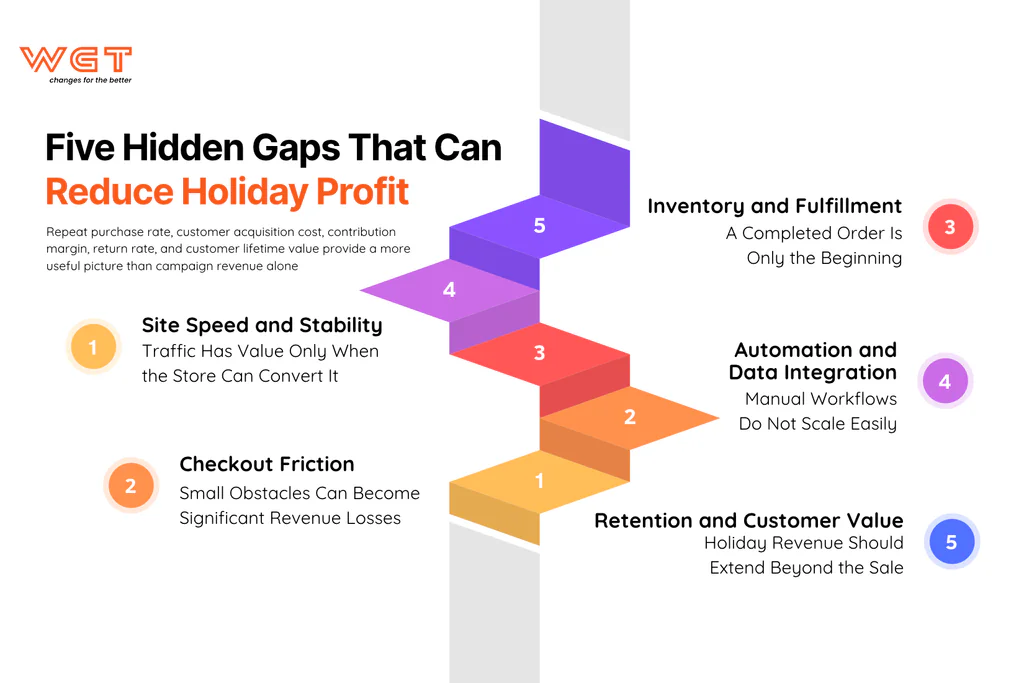
1. Site Speed and Stability: Traffic Has Value Only When the Store Can Convert It
Storefront performance is often treated as a technical concern, but its commercial impact is direct. When product pages load slowly, shoppers face delays before they can evaluate products, compare options, or add items to their carts. Under peak demand, unnecessary scripts, oversized images, poorly configured third-party apps, and inefficient integrations can compound these delays.
A useful real-world example is Skullcandy, which migrated to Shopify and reduced homepage load time from 2.8 seconds to 0.8 seconds, according to Shopify’s published case study. Shopify also reports that the brand achieved 45% year-over-year holiday revenue growth in its first full holiday season on the platform. This is a documented business outcome, not proof that faster loading alone caused the entire increase. The case nevertheless illustrates how a more responsive storefront can support experimentation and growth during a critical trading period.
For Shopify merchants, the practical priority is to measure performance on real mobile devices, review Core Web Vitals, audit third-party scripts, compress product imagery, and test important customer journeys under realistic load. The focus should be on the pages that influence purchasing decisions most directly, particularly product detail pages, collection pages, cart, and checkout.
2. Checkout Friction: Small Obstacles Can Become Significant Revenue Losses
A shopper who reaches checkout has already demonstrated meaningful purchase intent. Yet unnecessary form fields, unclear shipping costs, limited payment options, forced account creation, and confusing error messages can still interrupt the transaction.
Baymard Institute’s research places average documented eCommerce cart abandonment at approximately 70%. Its checkout usability research also estimates that large eCommerce sites could achieve a substantial conversion improvement through checkout design changes alone. These figures cover eCommerce more broadly, rather than Shopify stores specifically, but they demonstrate why checkout deserves executive attention.
The lesson from leading Shopify store examples is to remove unnecessary friction rather than assume that larger discounts are the only way to recover lost orders. Merchants should review mobile form usability, payment reliability, delivery information, guest checkout options, and the clarity of the final order total. Payment methods should match the markets and devices customers actually use.
For leadership teams, checkout performance should be monitored alongside the number of sessions reaching checkout, the percentage completing payment, payment failure rates, and the average order value of completed purchases. Improving one metric without understanding its effect on the others can create a misleading picture of success.
3. Inventory and Fulfillment: A Completed Order Is Only the Beginning
Holiday profitability can deteriorate after payment if inventory records are inaccurate, warehouse processes cannot keep up, or customers receive inconsistent delivery information. Overselling leads to cancellations and refunds, while delayed dispatch increases support demand and can damage customer trust.
These risks become more complex when a business sells through multiple channels, operates several warehouses, or uses separate systems for its Shopify store, enterprise resource planning (ERP), and warehouse management. If stock levels and order statuses are not synchronized reliably, teams may make decisions using outdated information.
A more resilient operation connects inventory visibility, order routing, fulfillment status, and customer notifications. Before the holiday period, merchants should test the complete order lifecycle, including low-stock scenarios, partial fulfillment, cancellations, returns, and failed integration events.
The benchmark that matters is not simply how many orders the store can accept. It is how consistently the business can fulfill those orders accurately, within its promised service levels, and at an acceptable cost. Merchants should establish targets using their own historical data, warehouse capacity, delivery commitments, and product margins rather than adopt an arbitrary universal threshold.
4. Automation and Data Integration: Manual Workflows Do Not Scale Easily
Many stores invest heavily in marketing automation while leaving operational processes dependent on manual intervention. Order tagging, inventory updates, customer segmentation, refund handling, and fulfillment notifications may rely on disconnected applications or workflows that have never been tested at peak volume.
The result is a gap between what the storefront promises and what the business can deliver. A customer may receive a promotion for an unavailable product, an order may remain unprocessed because an integration failed, or a support team may lack the information required to answer a delivery question.
Shopify Flow, email marketing platforms, ERP integrations, and CRM systems can help reduce repetitive work, but installing more apps is not the same as building a reliable automation architecture. Each workflow needs clear triggers, defined ownership, error handling, and monitoring.
Before peak season, businesses should identify critical dependencies and test how the system behaves when an API request fails, an event is duplicated, or an order volume spike creates a processing backlog. The priority is to make essential workflows observable and recoverable, not merely to automate as many tasks as possible.
5. Retention and Customer Value: Holiday Revenue Should Extend Beyond the Sale
Acquisition campaigns can become more expensive and competitive during major shopping events. If every purchase depends on a discount or a newly acquired customer, revenue growth may come with weaker margins and limited long-term value.
Retention offers a different path. Clear delivery communication, relevant product recommendations, loyalty benefits, replenishment reminders, and thoughtful post-purchase experiences can encourage customers to return without requiring the same level of acquisition spending for every order.
Shopify’s 2025 holiday retail research highlights the importance of helping shoppers manage budgets while delivering convenient and consistent experiences. Its examples include brands using bundles, starter kits, and loyalty programs to communicate value rather than relying exclusively on price reductions.
For merchants, the key is to measure retention in financial terms. Repeat purchase rate, customer acquisition cost, contribution margin, return rate, and customer lifetime value provide a more useful picture than campaign revenue alone. Segmentation should also reflect customer behavior and preferences, with appropriate consent and privacy controls.
ECOMMERCE GROWTH
Your eCommerce Platform Should Power Growth, Not Limit It.
From Shopify development to complex integrations, WGT Core helps ambitious eCommerce businesses build for performance and scale.
Shopify Store Examples: What High-Performing Brands Demonstrate
Public case studies provide useful evidence of what businesses can achieve when technology and commercial strategy work together. However, results should be interpreted in context. Brand size, product category, audience loyalty, promotional strategy, and existing infrastructure all influence performance, so published outcomes should not be treated as guaranteed benchmarks for every merchant.
Skullcandy: Technical Performance That Supports Growth
Skullcandy’s Shopify migration demonstrates the value of reducing technical constraints before scaling. Shopify reports that the company relaunched its US site in 90 days, reduced homepage load time from 2.8 seconds to 0.8 seconds, and recorded 45% year-over-year holiday revenue growth during its first full holiday season on the platform.
The broader lesson is that infrastructure should enable the business to launch campaigns, test ideas, and respond to demand without excessive development delays. Merchants evaluating their own technology stack should examine whether current platform limitations are slowing down commercial decisions or increasing the cost of change.
Represent: Preparing for Extreme Traffic Peaks
Represent offers another example of performance under seasonal demand. In a Shopify-published case study, the luxury streetwear brand is reported to handle a 25-fold increase in Black Friday traffic alongside an eightfold increase in conversions.
The takeaway is not that every store should expect similar growth multiples. It is that demand spikes must be supported by a storefront and checkout experience capable of handling them. Businesses should stress-test critical customer journeys, review app and script dependencies, and confirm that their monitoring can identify problems before they become widespread.
Blume: Making Value Clear for Budget-Conscious Shoppers
Blume appears in Shopify’s 2025 holiday retail report as an example of a brand using bundles and starter kits to appeal to customers seeking value. These offers can help shoppers understand the benefit of purchasing a set of products while encouraging larger baskets when the products genuinely complement one another.
For merchants, the opportunity is to develop offers that make commercial sense for both sides. Bundles should account for product margin, fulfillment costs, inventory availability, and likely returns. A larger average order value is useful only when the additional revenue contributes enough profit to justify the offer.
Which Shopify Benchmarks Should Leaders Track Before the Holidays?
Benchmarks are most useful when they combine external reference points with a store’s own historical performance. Industry averages help identify possible weaknesses, while internal data reveals whether the business is improving and whether the change has a financial impact.
Targets should reflect each store’s business model, category, geography, fulfillment capabilities, and previous performance. For example, a premium furniture retailer with long delivery lead times should not use the same fulfillment target as a cosmetics brand shipping small parcels from a local warehouse.
The leadership team should also connect operational indicators to financial outcomes. If page performance improves but conversion remains unchanged, investigate product relevance, pricing, and traffic quality. If conversion increases while contribution margin falls, review discount depth, acquisition costs, and fulfillment expenses before declaring the initiative successful.
A Practical Holiday Readiness Plan for Shopify Merchants
Preparation should begin with a clear view of the current store rather than a long list of disconnected technical tasks. The most effective approach is to identify the highest-risk customer journeys, quantify their commercial impact, and prioritize improvements based on the time and resources available.
During the first phase, establish baseline performance across site speed, checkout, inventory accuracy, fulfillment, and retention. Review historical holiday data to identify where sessions were lost, orders were delayed, refunds increased, or support demand spiked. This creates a fact-based view of the gaps that matter most.
Next, address the highest-impact constraints. Depending on the store, this may involve improving mobile performance, simplifying checkout interactions, correcting inventory synchronization, repairing unreliable integrations, or refining promotional offers. Changes should be tested in a controlled environment, with particular attention to payment processing, order routing, and third-party app compatibility.
Finally, prepare for ongoing monitoring. Assign owners to critical metrics, define escalation procedures for failures, and make sure teams can distinguish a traffic surge from a genuine performance incident. After the season, compare results with the baseline to determine which improvements increased conversion, protected margin, or reduced operational cost.
How WGT Core Helps Shopify Stores Prepare for Growth
Holiday readiness is not just a marketing exercise. It requires commerce infrastructure, customer experience, integrations, and growth strategy to work together.
As a growth-focused eCommerce technology partner, WGT Core supports businesses with Shopify development, theme and app customization, platform migration, and system integrations. These capabilities can help merchants address technical bottlenecks, streamline operational workflows, and build a foundation that supports future growth.
The right starting point depends on the business. A store struggling with slow pages may need a performance and app audit, while a merchant dealing with fragmented inventory may need a closer review of ERP integration and order workflows. Businesses with healthy operations but weak conversion may benefit more from checkout analysis, merchandising improvements, or conversion rate optimization.
The objective is to connect technical decisions to measurable commercial outcomes, rather than introduce complexity without a clear business case.
Preparing for the next holiday sales peak? Contact WGT Core to discuss your Shopify store’s performance, integrations, and growth priorities.
ECOMMERCE GROWTH
Your eCommerce Platform Should Power Growth, Not Limit It.
From Shopify development to complex integrations, WGT Core helps ambitious eCommerce businesses build for performance and scale.
Conclusion
The strongest Shopify store examples demonstrate that holiday profit depends on more than campaign reach or discount depth. Speed and stability help preserve purchasing intent, checkout improvements reduce avoidable friction, reliable integrations protect fulfillment, and retention strategies extend the value of each customer relationship.
For business leaders, the priority is to identify which gaps have the greatest effect on revenue and margin, then address them with measurable improvements. External benchmarks provide useful context, but the most valuable standard is a store’s own ability to convert demand, fulfill its promises, and retain customers as the business grows.
WGT Core helps businesses align Shopify technology with these commercial priorities, building better commerce experiences that support sustainable growth and greater operational confidence.