

Choosing an eCommerce platform is no longer just a technical decision. It influences how a business manages products, serves customers, processes orders, connects internal systems, and expands into new markets.
As digital commerce becomes more complex, businesses need platforms that can support more than a functional online storefront. They need flexible technology, reliable commerce infrastructure, connected operations, and the ability to adapt to changing customer expectations.
Shopify has remained one of the most recognized platforms in this space by continuously expanding its commerce capabilities. Its ecosystem combines online storefronts, checkout, payments, business integrations, point-of-sale capabilities, and an extensive app and developer ecosystem.
Its development in 2026 also reflects broader changes in commerce. Shopify has expanded native B2B capabilities, introduced more AI-powered tools, and continued developing infrastructure for commerce across emerging AI-driven channels.
But does Shopify still deserve its position as a leading eCommerce platform?
For businesses evaluating their next digital commerce investment, the answer depends on understanding what Shopify does well, how its capabilities have evolved, and whether its architecture aligns with their operational requirements.

1. What Makes Shopify a Leading eCommerce Platform?
Shopify is a cloud-based commerce platform that enables businesses to create and manage online stores, sell products, process transactions, and operate across multiple sales channels.
Unlike a traditional website builder, Shopify provides a broader commerce infrastructure. Businesses can manage product catalogs, orders, payments, customer information, discounts, and storefront experiences through a connected platform.
Its appeal comes from several interconnected capabilities.
A unified commerce environment
Shopify brings essential commerce functions together, reducing the need to manage every part of an online store through separate systems.
Businesses can manage products, orders, customers, inventory, and sales channels within the Shopify ecosystem. Additional applications and integrations extend these capabilities when more specialized requirements arise.
An extensive ecosystem
Shopify supports a large ecosystem of themes, apps, developers, technology partners, and service providers.
This gives businesses access to additional functionality without having to build every feature from scratch. It also creates opportunities for custom development when standard platform capabilities are not sufficient.
Scalability across business stages
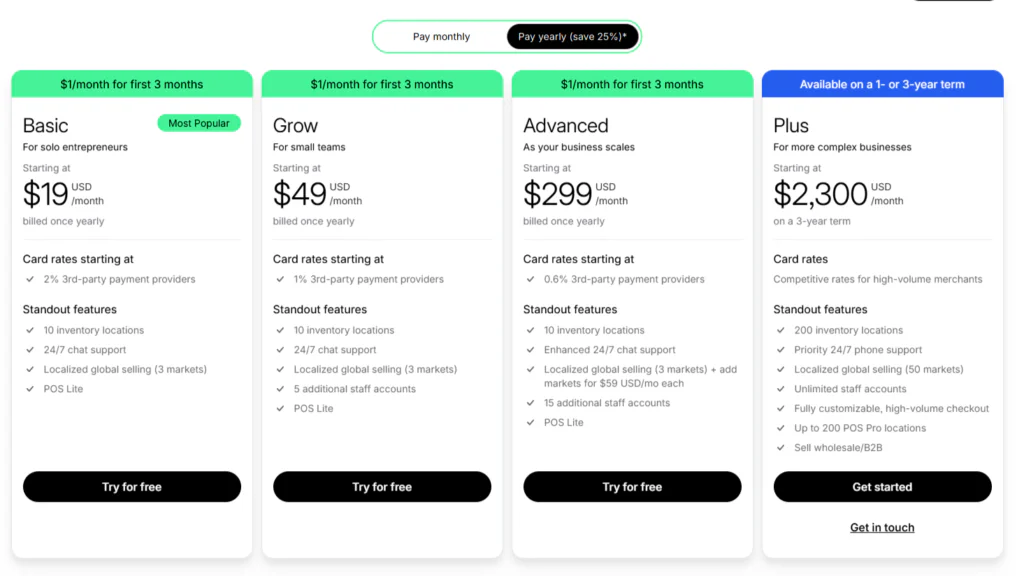
Shopify offers different plans and commerce capabilities for businesses with different operational requirements, from smaller merchants to more complex and enterprise-oriented operations.
For companies with more advanced requirements, Shopify Plus development can support more sophisticated commerce implementations and customization needs.
Continuous platform development
Shopify continues to introduce updates across storefront management, checkout, automation, analytics, B2B, and AI-assisted commerce.
These developments matter because businesses need their commerce infrastructure to evolve alongside customer behavior and changing market conditions.
However, a leading platform is not automatically the right platform for every business. Its suitability depends on factors such as catalog complexity, integration requirements, customization, operating model, and total cost of ownership.
2. Why Shopify Still Stands Out in 2026
Shopify’s position is supported not only by its established commerce capabilities but also by its continued investment in areas that are becoming increasingly important to digital businesses.
Several developments in 2026 illustrate this direction.
Native B2B Capabilities Are Becoming More Accessible
B2B commerce has traditionally required more complex workflows than standard direct-to-consumer transactions.
Wholesale businesses often need company accounts, customer-specific pricing, volume discounts, payment terms, and purchasing rules. Managing these requirements through separate applications can increase operational complexity.
On April 2, 2026, Shopify announced the expansion of foundational native B2B features to merchants on Basic, Grow, and Advanced plans.
The announced capabilities include:
- Company profiles for wholesale buyers.
- Up to three custom catalogs with tailored pricing.
- Volume discounts and quantity rules.
- Vaulted credit cards.
- Payment terms.
This is an important development because it makes selected B2B commerce capabilities available beyond Shopify Plus.
For businesses operating both wholesale and direct-to-consumer channels, having these capabilities within the same commerce environment can reduce the need for disconnected tools.
However, more advanced B2B requirements may still require Shopify Plus, custom development, or third-party integrations. Businesses should evaluate their specific pricing structures, purchasing workflows, company account requirements, and ERP dependencies before selecting a solution.

AI Is Becoming Part of the Commerce Infrastructure
AI is changing how businesses manage digital commerce and how customers discover products.
In its Spring ’26 Edition, announced on June 17, 2026, Shopify continued expanding its infrastructure for agentic commerce. Its developer ecosystem gained broader access to tools supporting commerce experiences within AI-powered interactions.
This direction is significant because product discovery is no longer limited to traditional search engines, social platforms, or marketplace browsing.
AI-powered experiences create additional ways for customers to research products, compare options, and interact with brands.
For merchants, this introduces new considerations around product information, structured catalogs, product availability, and the consistency of commerce data across channels.
Shopify’s investment in agentic commerce reflects an effort to make merchant products accessible across emerging AI-driven shopping experiences.
For businesses, the strategic priority is not simply adopting AI features. It is ensuring that their commerce data and infrastructure are reliable enough to support these new channels.
Continuous Improvements to Store Management
Shopify also continues to refine the day-to-day experience of managing an online business.
Its official changelog on November 10, 2026, included an update allowing merchants to configure self-serve returns and cancellation availability by individual market rather than applying one store-wide setting.
This is relevant for businesses selling internationally because customer service policies and operational requirements may differ between markets.
The changelog also includes improvements to Shopify’s AI assistant, Sidekick, including assistance with checkout and customer account configurations.
These updates demonstrate how the platform continues to evolve beyond storefront creation into broader commerce operations.
For growing businesses, the value of these developments lies in reducing operational friction and providing more flexibility as business requirements become more complex.
ECOMMERCE GROWTH
Shopify Case Studies: Lessons from Top Brands for Peak Seasons
Peak shopping seasons create some of the biggest opportunities for ecommerce brands, but they also expose weaknesses in the technology and operations behind an online store.
3. Key Shopify Features That Support eCommerce Growth
Shopify’s value comes from the way its core capabilities work together. Businesses can use its native functionality as a foundation and extend it through themes, apps, integrations, and custom development.
Flexible Storefront and Theme Customization
A storefront is more than a visual representation of a brand. It directly influences how customers discover products, evaluate information, navigate the catalog, and complete purchases.
Shopify provides themes and storefront customization tools that allow businesses to build online shopping experiences without developing every component from scratch.
However, businesses with more specific requirements may need additional customization.
Examples include:
- Custom product and collection page layouts.
- Advanced navigation and filtering.
- Brand-specific shopping experiences.
- Custom landing pages for campaigns.
- Improved mobile shopping experiences.
- Performance-focused theme optimization.
A well-designed storefront should balance visual identity, usability, performance, and conversion objectives.
Businesses looking to improve these areas can explore Shopify theme development to create storefront experiences that align with their brand and commercial requirements.
Integrated Checkout and Commerce Operations
Checkout is one of the most commercially important parts of an online store.
A complicated checkout experience can create unnecessary friction, while disconnected payment and order processes can introduce operational problems.
Shopify provides a managed checkout environment with built-in commerce functionality, alongside customization options that depend on the merchant’s plan and technical requirements.
Businesses can configure payment methods, shipping settings, taxes, discounts, and other checkout elements based on their operating model and market availability.
The broader advantage is that checkout operates within the same commerce environment as product and order management.
However, businesses should not assume that every checkout customization is available on every Shopify plan. Advanced requirements need to be assessed against current platform capabilities and applicable plan limitations.
Apps and Third-Party Integrations
No single commerce platform can provide every capability required by every business.
As companies grow, they may need specialized applications for marketing automation, customer support, loyalty programs, product reviews, subscriptions, analytics, and inventory management.
Shopify’s app ecosystem allows merchants to extend their stores with these additional capabilities.
For more complex operations, businesses may also need integrations with:
- Enterprise Resource Planning (ERP) systems.
- Customer Relationship Management (CRM) platforms.
- Inventory and warehouse management systems.
- Payment and financial applications.
- Shipping and fulfillment providers.
- Marketing and customer engagement platforms.
These connections are important because disconnected systems can create inconsistent information and additional manual work.
A structured Shopify integration solution can help synchronize data across business applications and support more efficient operations.
The key is to select integrations based on actual business requirements rather than installing applications simply because they are available.
Multi-Channel and International Commerce
Customers increasingly interact with brands through different channels, including online stores, social platforms, marketplaces, and physical retail locations.
Shopify supports multiple sales channels and provides tools that help businesses manage commerce activities across different customer touchpoints.
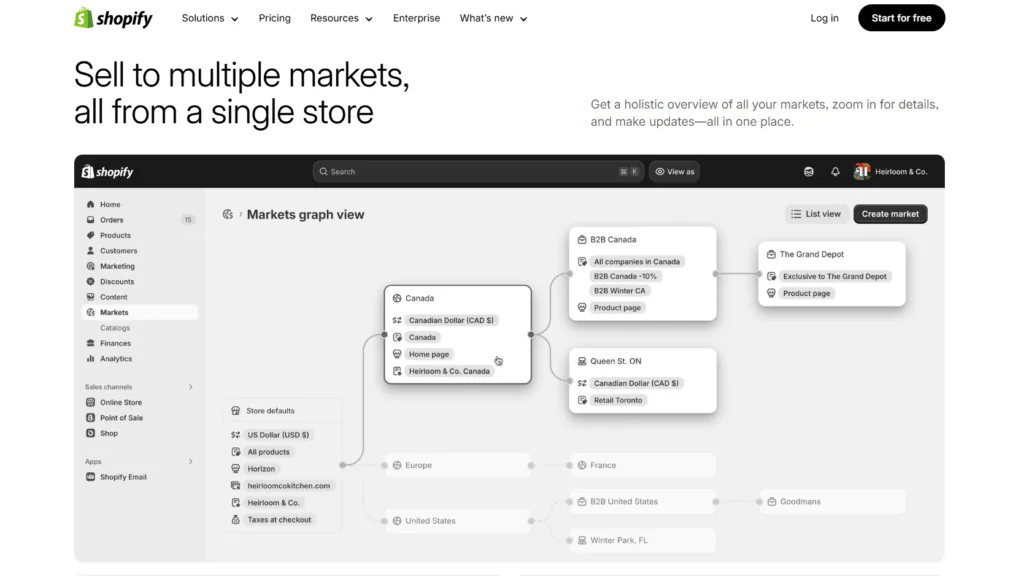
For businesses expanding internationally, Shopify also provides market-related capabilities that can support localized selling.
Depending on eligibility and configuration, merchants can manage aspects of international commerce such as localized storefront experiences, currencies, and market-specific settings.
However, international expansion involves more than enabling additional markets. Businesses must also consider local payment methods, tax obligations, shipping operations, product regulations, and customer service requirements.
Shopify provides part of the technology foundation, but the business remains responsible for ensuring that its international operating model is appropriate for each market.

4. Shopify vs. Traditional eCommerce Platforms: What Makes the Difference?
When evaluating an eCommerce platform, businesses often compare Shopify with solutions such as Adobe Commerce (Magento), WooCommerce, and other enterprise commerce platforms.
Each platform has a different architecture and operating model. The right choice depends on the organization’s technical resources, customization requirements, budget, and growth strategy.
| Evaluation Criteria | Shopify | Adobe Commerce (Magento) | WooCommerce |
|---|---|---|---|
| Platform model | Hosted SaaS commerce platform | Flexible commerce platform with cloud and self-managed deployment options | Open-source commerce plugin built on WordPress |
| Infrastructure management | Shopify manages the core hosting infrastructure | Infrastructure responsibility depends on the selected deployment model | Hosting and infrastructure are generally managed separately |
| Ease of management | Centralized administration and managed commerce environment | Greater technical complexity, especially for customized implementations | Familiar for WordPress users, but requires ongoing plugin and infrastructure management |
| Customization | Themes, apps, APIs, and custom development | Extensive customization and architectural flexibility | Themes, plugins, extensions, and custom development |
| Integrations | App ecosystem, APIs, and custom integrations | APIs, extensions, and enterprise integration capabilities | Plugins, APIs, and custom integrations |
| B2B capabilities | Native B2B features, with capabilities varying by plan | Advanced B2B capabilities depending on edition and implementation | Often requires plugins or custom development |
| Maintenance | Core platform maintenance is managed by Shopify | Requires platform, infrastructure, and extension maintenance according to deployment | Requires ongoing management of WordPress, WooCommerce, hosting, themes, and plugins |
| Best suited for | Businesses seeking managed commerce infrastructure and a connected ecosystem | Businesses requiring extensive customization and control over their commerce architecture | Businesses seeking flexibility within the WordPress ecosystem |
Shopify’s key advantage is its managed commerce environment and integrated ecosystem. Businesses can focus more on storefront development, customer experience, and operations without having to manage the entire underlying infrastructure.
Adobe Commerce may be more appropriate when a business requires extensive customization, complex catalog structures, or greater architectural control.
WooCommerce can be attractive for businesses already operating within WordPress or requiring a more flexible open-source setup.
There is no universally superior platform. The best choice is the one that supports the company’s operational requirements without creating unnecessary technical or financial complexity.
ECOMMERCE GROWTH
10 Best Shopify Loyalty Apps to Increase Repeat Purchases
Customer retention is no longer optional for growing eCommerce brands, it’s a must. And on Shopify, one of the most effective ways to encourage repeat purchases and build brand advocacy is by launching a well-structured loyalty program.
5. Is Shopify Suitable for Growing and Enterprise Businesses?
Shopify is often associated with small and medium-sized online stores, but its capabilities extend beyond basic storefront operations.
The platform offers different levels of functionality for businesses with more demanding requirements, including Shopify Plus.
Shopify for Growing Businesses
For growing businesses, Shopify can provide a relatively straightforward way to establish and expand digital commerce operations.
Its managed infrastructure, administration tools, themes, and app ecosystem can help reduce the amount of custom infrastructure development required.
As operations become more complex, businesses can extend their stores through integrations and custom development.
Typical priorities include:
- Improving storefront performance.
- Expanding product catalogs.
- Connecting inventory and order management systems.
- Improving customer experience.
- Supporting additional sales channels.
- Building more effective marketing workflows.
The challenge is to ensure that the technology foundation evolves alongside the business rather than accumulating disconnected applications and unnecessary customizations.
Shopify Plus for More Complex Commerce Operations
Shopify Plus is designed for businesses with more advanced commerce requirements.
It provides additional capabilities and customization options for organizations managing more complex operations, including B2B commerce, checkout customization, and multi-store or multi-market requirements.
Potential use cases include:
- Wholesale and direct-to-consumer operations.
- More advanced checkout requirements.
- Complex integration environments.
- Multiple brands or storefronts.
- Higher levels of operational customization.
- More sophisticated commerce workflows.
However, Shopify Plus is not automatically necessary for every growing business.
The decision should be based on actual operational requirements, expected benefits, implementation costs, and the limitations of the current plan.
Businesses evaluating an upgrade can explore Shopify Plus development services to understand how advanced platform capabilities can be aligned with their commerce architecture.
6. Common Shopify Challenges Businesses Should Consider
Although Shopify offers significant advantages, businesses should understand its limitations before committing to the platform.
Platform Dependency and Customization Constraints
Shopify operates as a managed platform. This reduces infrastructure management responsibilities but also means merchants work within Shopify’s platform architecture and supported customization mechanisms.
Businesses with highly specialized requirements may need custom applications, APIs, or alternative architectural approaches.
Not every feature can be modified in the same way as a fully self-managed platform.
Before implementation, companies should identify which requirements can be handled through native features, which require apps, and which need custom development.
App Costs and Technical Complexity
The Shopify app ecosystem provides flexibility, but installing too many applications can increase subscription costs and create technical dependencies.
Multiple apps may also introduce overlapping functionality, inconsistent data, or performance issues.
Businesses should regularly review their application stack and prioritize tools that contribute measurable value.
A more efficient architecture often involves fewer, better-integrated applications rather than a large collection of disconnected tools.
Advanced Integration Requirements
Standard integrations may not be sufficient for businesses with complex ERP, CRM, inventory, or fulfillment environments.
Custom data mapping, synchronization rules, error handling, and API management may be required.
These projects should be planned carefully because integration problems can affect order accuracy, inventory visibility, customer information, and financial reporting.
Migration Complexity
Moving from another eCommerce platform to Shopify involves more than transferring products and customer records.
Businesses may need to migrate:
- Product catalogs and variants.
- Customer accounts and records.
- Order history.
- Product images and digital assets.
- URLs and SEO metadata.
- Content and blog resources.
- Integration workflows.
- Operational business rules.
SEO migration is particularly important. URL changes, incorrect redirects, missing metadata, and lost content can affect organic search visibility.
For businesses moving from Adobe Commerce or Magento, a structured Magento to Shopify migration should include data mapping, URL planning, integration assessment, and pre-launch testing.
Similarly, a WooCommerce to Shopify migration should account for WordPress content, product data, plugins, customer information, and existing search visibility.
A migration should be treated as a business and technical transformation project, not simply a platform switch.
7. How to Build a Successful Shopify eCommerce Strategy
Choosing Shopify is only the starting point. Businesses need a clear implementation strategy to ensure that the platform supports their commercial objectives.
Step 1: Define Business and Technical Requirements
Start by identifying what the business needs from its eCommerce platform.
Consider:
- Target customer segments.
- Product catalog complexity.
- B2B and B2C operating models.
- Current sales channels.
- Payment and fulfillment requirements.
- ERP and CRM dependencies.
- International expansion plans.
- Customization and scalability requirements.
These considerations help determine whether Shopify’s native capabilities are sufficient or whether additional development is necessary.
Step 2: Design the Right Commerce Architecture
A successful Shopify implementation should consider how the storefront interacts with the rest of the business.
Map the required data flows between Shopify and systems such as ERP, CRM, inventory management, payment providers, and fulfillment applications.
Avoid unnecessary integrations and duplicated functionality. Every additional application should have a clear purpose and an owner responsible for maintaining it.
Step 3: Prioritize Storefront Experience and Performance
The storefront should reflect the brand while making it easy for customers to discover products and complete purchases.
Prioritize:
- Clear navigation and information architecture.
- Mobile-friendly layouts.
- Useful product information.
- Effective search and filtering.
- Consistent visual design.
- Fast-loading pages.
- A straightforward checkout journey.
Businesses with specific brand and functionality requirements may benefit from tailored Shopify theme development rather than relying entirely on a standard theme.
Step 4: Plan Integrations and Automation
Identify repetitive workflows and disconnected processes that can be improved through integrations and automation.
Examples include order synchronization, inventory updates, customer data management, and fulfillment notifications.
Before going live, test data accuracy, synchronization frequency, error handling, and recovery procedures.
Step 5: Establish a Continuous Optimization Process
Launching an online store does not mean the development process is complete.
Businesses should continuously evaluate:
- Storefront performance.
- Product discovery.
- Conversion rates.
- Checkout behavior.
- Customer retention.
- Application performance.
- Integration reliability.
- Operational efficiency.
Use analytics and customer feedback to identify improvements, then prioritize changes based on commercial impact.
8. How to Measure the Success of a Shopify Store
A successful Shopify implementation should be measured through business performance, not simply the completion of development tasks.
The following KPIs provide a practical framework for evaluating the impact of a Shopify store:
| Measurement Area | Key Performance Indicators (KPIs) | What to Measure |
| Storefront Performance | Page loading performance | How quickly important storefront pages load and respond to customer interactions. |
| Core Web Vitals | Loading performance, interactivity, and visual stability using Google’s Core Web Vitals metrics. | |
| Mobile usability | Whether customers can navigate, browse products, and complete purchases effectively on mobile devices. | |
| Sales & Conversion | Conversion rate | The percentage of store visitors who complete a purchase. |
| Average order value (AOV) | The average revenue generated per order. | |
| Cart abandonment rate | The proportion of shopping carts that do not result in completed purchases, using a consistent measurement method. | |
| Revenue per visitor | The average revenue generated for each store visitor. | |
| Customer Performance | Customer retention rate | The percentage of customers who continue purchasing over a defined period. |
| Repeat purchase rate | The proportion of customers who make more than one purchase. | |
| Customer lifetime value (CLV) | The estimated total value generated by a customer throughout the relationship with the business. | |
| Operational Efficiency | Order processing time | The time required to process an order from placement to fulfillment readiness. |
| Inventory accuracy | The consistency between recorded inventory and actual stock levels. | |
| Integration reliability | How consistently Shopify exchanges data with connected business systems. | |
| Manual processing hours | The amount of employee time spent on repetitive tasks that could be streamlined or automated. |
Businesses should establish baseline measurements before implementing major changes. This makes it easier to understand whether a new theme, integration, or platform upgrade has produced meaningful improvements.
KPIs should also reflect the business model. A B2B store may prioritize account-based purchasing, quote requests, and order processing efficiency, while a DTC retailer may focus more heavily on conversion, average order value, and repeat purchases.
Conclusion: Shopify Remains a Strong Foundation for Modern eCommerce
Shopify continues to evolve beyond a platform for building online stores. Its expanding B2B capabilities, AI-related developments, integrated commerce tools, and broad technology ecosystem make it a strong option for businesses looking to modernize and scale their digital commerce operations.
Its main advantage lies in providing a managed commerce foundation that businesses can extend through themes, applications, integrations, and custom development.
However, platform selection should always reflect business requirements. Companies with complex operations need to evaluate customization, integration, migration, and total cost of ownership before making a decision.
The real opportunity is not simply to launch a Shopify store. It is to build a connected commerce environment that supports customer experience, operational efficiency, and sustainable business growth.
At WGT Core, we help businesses build, customize, integrate, and modernize their eCommerce platforms. From Shopify development and Shopify Plus solutions to platform migration and system integration, our focus is on creating technology foundations that support long-term commerce growth.
ECOMMERCE GROWTH
Your eCommerce Platform Should Power Growth, Not Limit It.
Explore our eCommerce development services to discover how the right Shopify implementation can support your next stage of growth.